


Dolphin Island
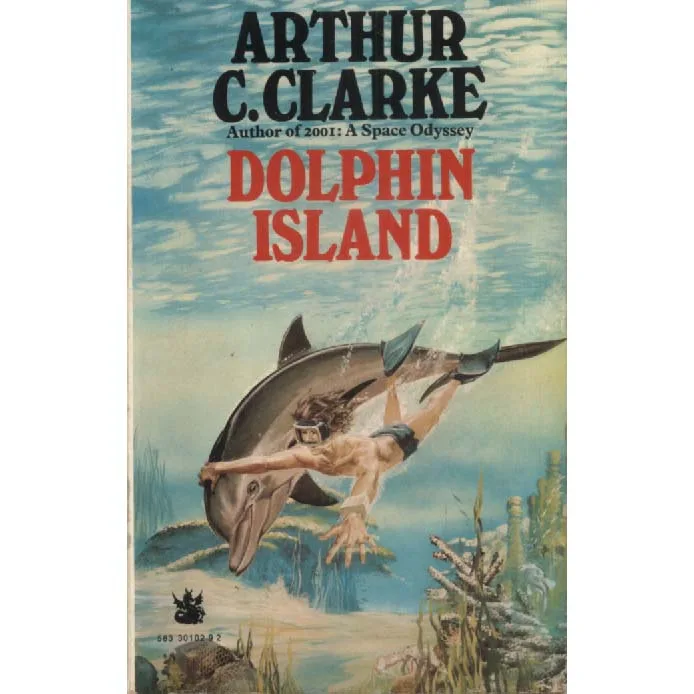
Publisher: Dragon Books
Format: Paperback
ISBN: 5833010292
Dolphin Island (1973) by Arthur C. Clarke
Dragon Books
ISBN: 5833010292
Condition: Good
Arthur C. Clarke is best known for vast spaceships, alien intelligence, cosmic mysteries and humanity discovering that the universe is considerably stranger than expected.
Dolphin Island takes a slightly different approach.
There are still mysteries.
There is still science.
But this time, there are dolphins.
And, frankly, the dolphins are doing rather well.
Originally published in the 1960s, Dolphin Island is one of Clarke’s more accessible adventures, combining near-future science fiction with marine biology, exploration and the enduring suspicion that some animals may be considerably more intelligent than humans have given them credit for.
The story follows Johnny Clinton, a young runaway who finds himself swept into a remarkable world of scientific research after circumstances carry him far from the ordinary life he was trying to escape.
And when Arthur C. Clarke sends a young man somewhere unusual, he does not merely put him on a different bus route.
Johnny eventually arrives at Dolphin Island, a research centre devoted to the study of dolphins and their extraordinary abilities.
This turns out to be rather more interesting than whatever he had originally planned.
The scientists there are investigating dolphin communication, intelligence and behaviour, working on the possibility that humans might one day be able to communicate properly with another species.
Not train it.
Not teach it tricks.
Actually communicate.
Which raises the slightly uncomfortable possibility that after centuries of congratulating ourselves on being the cleverest creatures on Earth, we may eventually discover that the dolphins have opinions.
Probably about us.
Clarke was fascinated by science and the possibilities of communication beyond ordinary human experience, and Dolphin Island applies those interests to the natural world rather than deep space.
The ocean becomes its own unexplored frontier.
This makes a certain amount of sense.
People frequently talk about exploring distant planets while remaining surprisingly uncertain about what is happening a few hundred metres beneath the nearest stretch of water.
The dolphins themselves are portrayed not merely as charming marine mammals but as intelligent beings capable of complex behaviour, cooperation and perhaps much more.
They are fast.
Social.
Highly adapted to their environment.
And they have achieved all this without inventing traffic wardens.
So their civilisation may already have certain advantages.
Clarke uses the story to introduce readers to ideas about marine science, animal intelligence and ocean exploration without turning the book into a biology textbook.
The science is woven into the adventure.
Johnny learns as the reader learns, gradually discovering that the world beneath the sea is every bit as extraordinary as anything Clarke might have placed on another planet.
There is also a wonderfully optimistic streak running through the book.
Science here is not merely something conducted by sinister laboratories with flashing lights and somebody shouting that the reactor is unstable.
It is curiosity.
Observation.
Experiment.
A desire to understand something previously unknown.
In other words, the sort of science fiction in which scientists are actually allowed to be interested in science.
The setting gives the novel much of its charm.
Dolphin Island is remote, specialised and filled with people working on unusual problems.
It has the feeling of a place slightly detached from ordinary society, where strange ideas are allowed to become serious projects.
This was something Clarke understood very well.
He liked the idea of intelligent people being given difficult questions and enough equipment to start causing trouble.
The book also reflects the period in which it was written, when public fascination with dolphins, undersea exploration and animal communication was growing rapidly.
The oceans still seemed filled with technological and biological possibilities.
Perhaps humanity would build great underwater communities.
Perhaps we would communicate with whales and dolphins.
Perhaps the future would involve a great deal more neoprene than anyone had previously anticipated.
Some of these predictions have progressed more slowly than hoped.
The dolphins, meanwhile, remain patiently enigmatic.
For younger readers, Dolphin Island works as a straightforward adventure.
For older readers, it becomes something more interesting: a snapshot of Clarke’s scientific optimism and a reminder of an era when the future was imagined not only in rockets and computers but also in oceans, research stations and the possibility of discovering intelligence already living beside us.
There is danger, discovery and plenty of marine adventure, but the real appeal lies in the sense of curiosity.
What might dolphins actually understand?
How much can humans learn from them?
And if we ever manage a proper conversation, how long will it take before one of them asks why we keep throwing plastic into their house?
This 1973 Dragon Books edition is in Good condition, which suggests it has survived considerably better than most paper objects exposed to the sea.
Ideal for Arthur C. Clarke collectors, vintage science-fiction readers, marine-life enthusiasts or anyone who prefers their intelligent non-human life forms to arrive without invading Earth.
Available from Crappy Old Books, where the dolphins remain uncontactable, but the books are considerably easier to communicate with.
Keep browsing: See more Science-Fiction books Other books by Arthur C Clarke
